Loca-busy? Locavore?

Sunday, October 19, 2014

Day 1 of Shopping at Home: Curried Zucchini Soup


 Well, I survived Day 1 of shopping at home.  No farmer’s market!  No quick trip to the grocery!  I was sorely tempted, but…my first priority was to get rid of leftovers, which we did for the most part at lunch.  Second, I needed to pay full attention to my vegetable drawer, the first place I end up wasting food.  I tend to over-buy fresh veggies anyway, and having a garden this summer exacerbated that problem.  I opened my veggie drawer and found the most pressing to be the last of my garden zucchini, a half of my last monster zucchini left over, and another which had been sadly neglected.  I looked over my recipe from my not-so-new New Basics Cookbook; the recipe called for six zucchini.Well, the size of these could count for at least three store-bought zucchini, I thought.  I cut the bad spots off and grated them with my box grater to make about three cups. Guess I would have to start foraging in the freezer for the rest.


A trip to the freezer meant Discovery and Purging (heretofore referred to as D & P).

Discovered:  1. Store brand frozen onions.  I have no idea what possessed me to buy frozen diced onions, except maybe they were on sale, or maybe I thought about those very few times in my life I haven’t had onions in the house, or haven’t felt like cutting them up.  No date on them, but I don’t remember buying them.  Oh, well, worth a try.
2.  Shredded frozen yellow squash.  Again, no date (boo!), but I do remember shredding and freezing a lot of yellow squash last summer.  Or was it the summer before…? These could be used in place of zucchini.
3.  Two containers of Triple S chicken broth, one container with a cracked lid.  These needed to be rescued for sure.  There was a generous layer of fat on top that could be scooped off before adding to the soup.
4. Three wild-caught cod fillets.  I was craving fish, and it would be a nice accompaniment to the soup.
5.  Frozen fried apples.  Dessert would be easy.

Purged:  1. Edamame, freezer-burnt to a pale yellow color.  Ick. 
2. A bag of corn from 2009.  Wasn’t sure it was still corn.
3. A package of Mission whole-wheat tortillas, now mostly in tiny pieces after being jostled about for a substantial amount of time.

I managed to sauté the frozen onions in butter after cooking off the inevitable goopy water that comes with frozen vegetables.  I added three tablespoons of curry instead of five, as I knew my son wouldn’t like that much zing.  I added the partially thawed, de-fatted broth and three peeled and diced potatoes, and brought to a boil.  After the potatoes cooked, I added salt, pepper, the shredded zucchini, and the shredded yellow squash, then brought to another boil and simmered for 15 or 20 minutes while my fish was baking (I had prepped the fish with a simple spritz of coconut oil and a topping of gomasio, a simple but tasty blend of sesame seeds and sea salt). I substituted a can of coconut milk for the cream in the soup recipe, then used my immersion blender to make it creamy.  The color was an inviting yellow, the color of most of the leaves covering our lawn.
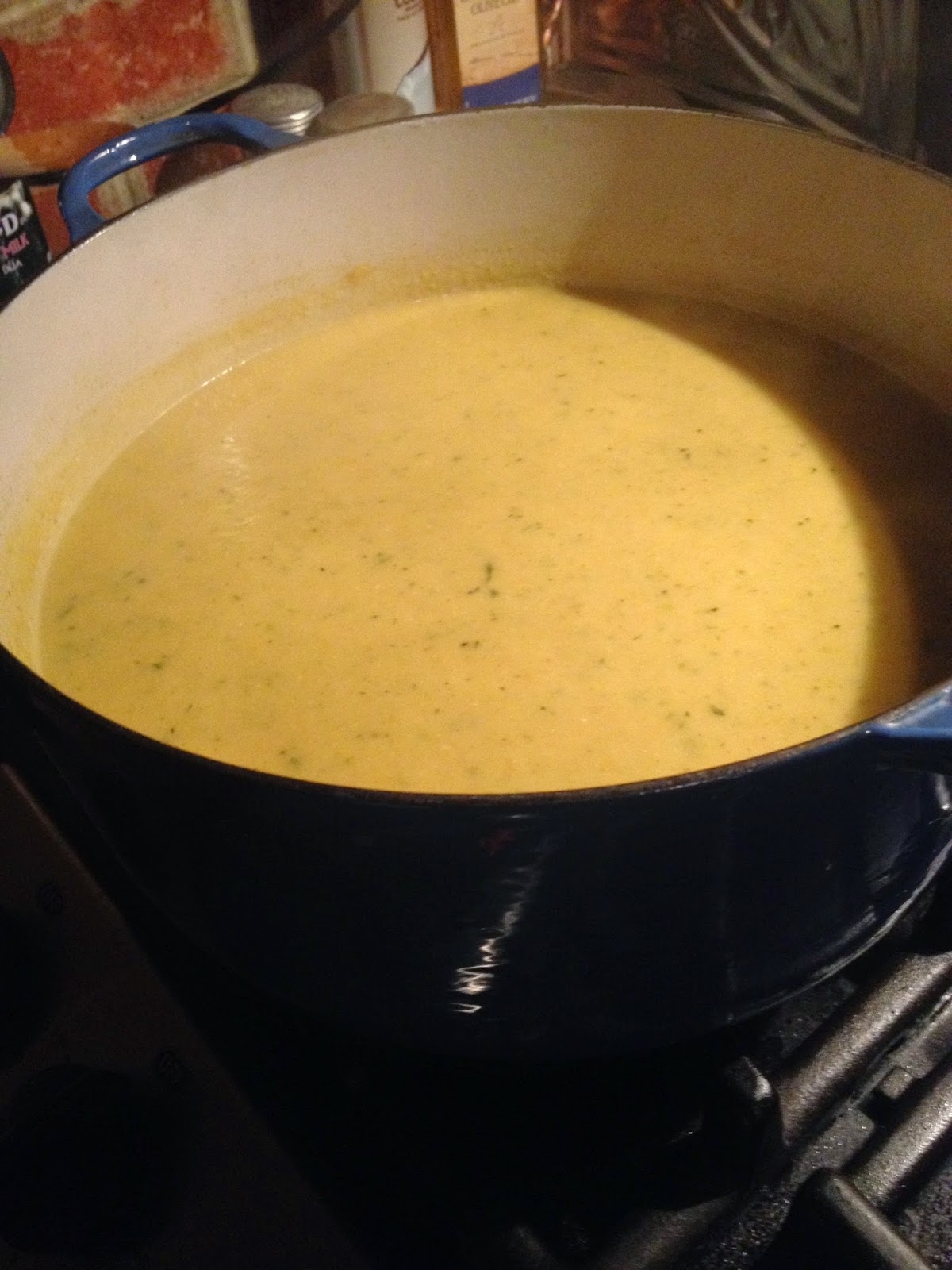
I heated the frozen fried apples up on the stove, and then served them warm with a dollop of the last of the season’s vanilla custard from our local Jarling’s Custard Cup.

The result was a perfect, warming fall meal.  So far, so good, and leftovers for lunch tomorrow!

Friday, October 17, 2014

Shopping at Home


A quart Ziploc bag labeled “greens” with something dark and dried up inside.  A plastic container with a cracked lid from Triple S marked “chicken broth.”  Honkin’ big bags of almonds, pecans, and walnuts from the big box store.  Separate bags of grocery store frozen veggies.  A humungous bag of mixed frozen fruit from when my stepson was living on smoothies after his accident.  Corn from two years ago (from a crop that I remember as being particularly starchy).  Blackberries bought frozen from farmer Greg.  My last Triple S meat order—plastic shrink-wrapped packages spilling willy-nilly—where I over-ordered everything, including dog bones.  A soup which only I liked, so I froze small portions for lunches, then never thawed them.  A precious package of wild-caught smoked salmon from Trader Joe’s, saved for a holiday or brunch.  Ten (!) loaves of bread from half-off Sundays at Pekara Bakery. Cheesecake cut into squares, left over from my son’s birthday. More Ziplocs with shredded yellow squash and zucchini mixed together, a perfect soup filler.  How will I ever be able to empty all of this out enough to defrost my freezers, or even one of my freezers?

How long do things last, I ask myself?  Well, if you turn to the internet, anything over a year old should be tossed, six months for meat or prepared foods.  But I know that a few years ago I managed to turn some ancient, frost-covered raspberries into a delightful jam.  And big veggie soups can disguise that a vegetable has gone from frozen to freeze-dried.  Corn seems to last forever, especially for corn chowder.  Hmmm…

I’m a terrible food hoarder, as I’ve mentioned before.  While others are scouring Pinterest or Houzz for bathroom remodels or wreath design, I am drooling over photos of pantries.  In my current house, in a wonderfully remodeled kitchen, my cabinets have overflowed to the basement. Our basement pantry sits under the front porch, approximately 2’ x 5’, four shelves and a covered floor.  
Having this in the basement forces me to exercise a bit to fetch what I need
In it:  cereal, juice, hot chocolate dry mix, Trader Joe’s backups of ketchup, mayo, tartar sauce, cornichons, capers, roasted red peppers, mustard, jams, canned fish, quinoa, rice, couscous; wine, several different bottles of hard alcohol, liqueurs and mixers which we almost never indulge in; pasta, dried beans, canned tomatoes, canned pumpkin, canned sauerkraut, canned beans, canned coconut milk; boxes of protein bars, fruit cups, juice, crackers, graham crackers for my son’s lunch; on the floor are boxes of La Croix, San Pellegrino, chicken stock, vegetable stock, and beer. And these are not exhaustive lists, by the way.  I forgot about oil, nut butters, popcorn, vinegars, flour, sugar, salt…Move to the back room and you’ll see two chest freezers and an old secondhand fridge (whose freezer door has long been frozen completely shut, who knows what’s behind it…?). 
What's inside the mystery freezer?  We may never know...

Just one of my freezers, filled to the brim
The fridge stashes our backup of local eggs, bulk yogurt, almond milk, and our recent haul of apples from Wolfe Orchard. 

I used to live in an apartment with a tiny kitchen and a single refrigerator with a miniscule freezer.  I had one small cabinet containing canned goods, pasta, cereal, baking goods, and spices.  Soon after my husband moved in—and before I started needing to store breast milk—we bought a cube-proportioned chest freezer for the basement; it was almost never full.  I’m not sure at what point of home-ownership or married family life that I went over the top to start over-storing food.  In this post in my other blog about Surviving Winter’s Worst, I talk a bit about my food hoarding tendencies.  I’m not sure if I have a fear of the zombie apocalypse, or if I just hate endlessly running to the grocery store, but whatever it is has resulted in having to go through my storage areas every once in a while and throwing out stored food long past its glory.  And I hate throwing food away.

A friend recently posted on Facebook her family’s intention to go shopping at home.  They would try to use only ingredients they could find on their shelves.  The first example was a minestrone soup and a big cheese bread; they had every ingredient except for the yeast.  I took this a challenge; how long could I go without going to the store?  I would perhaps allow myself one ingredient per day (celery and lemons never seem to be there when I need them, for example) to buy at the store, but everything else would come from home. I just did a big box store run for perishables, so I should at least be able to go a week without buying food.  I will not even go to the farmer’s market—gasp!  I will post my progress here!  My creativity will be kindled, my frugality at a peak, my family will be inspired, and hopefully my freezers and fridges and shelves will be cleared out in no time! 

And then I can fill them up again. After all, the holidays are coming…

Thursday, October 9, 2014

The Not-Cucumber


I started removing the vegetable garden about a week ago, but haven’t been able to finish up until yesterday.  All week my husband has been asking (in his funny French accent), “Did you see the long, big, coh-cohm-ber?”  And every day I look for the “coh-cohm-ber” and can’t find it.  What is he seeing that I can’t see?  I ask myself.  My cucumbers were a vibrant yellow variety this year, as I’ve mentioned, and would reflect the slanting rays of fall sunlight.  But every day as I pass by after walking the dog, I can find nothing.

Yesterday was one of those perfect fall days you don’t want to end.  The sky was a deep, deep blue, the sun was hot, and the breeze was almost musical.  I grabbed my gloves and pulled up stakes, snapped zip-ties, shook clumps of dirt from root balls, and folded up my vines into compost bags.  I found my labels and washed them off to remember what I planted for next year.  I grabbed the monstrous zucchini vine last of all….and there it was.  Not a “coh-cohm-ber” at all, but a giant, hulking, dark green, hard-to-miss zucchini. Three and a half pounds of not-cucumber.  And three hours later it became not-cucumber bread.


Freshly washed not-cucumber; with a wine bottle, for size comparison


That same husband also picked a huge number of hard, green tomatoes out of the compost when he got home and brought them proudly into the kitchen.  “Here!” he said, triumphantly.  “I brought you these!”  I am pretty sure he knows they’re tomatoes.

I think next year we might need a bit of training.


Tuesday, October 7, 2014

Meatless Monday and the Chicken Fish Mushroom


Sometimes it’s difficult for me to experiment with new foods or combinations of foods.  I, like anyone, get into a food rut fairly often.  Fortunately, two factors help shake me out of my rut periodically:  meatless Mondays and Claybank Farms’ Farmer Greg.

Meatless Mondays are a way to incorporate more vegetarian entrees into your diet, but without a huge commitment.  I’m always on the lookout for simple vegetarian fare for Monday evenings, and often a fun recipe will catch my eye from my regular email, blog, or Facebook feeds.  Not so yesterday, though.  I was looking for vegetarian comfort food, and not finding it.  And that’s when I thought of the chicken mushrooms.

Greg at Claybank Farms has started a new CSA-type buying club this summer for some of his quick-to-go farmer’s market items.  You pay a certain sum up front (say, $100 or so), Greg calls each Wednesday and gives you a list of his “special offerings” for the coming weekend, then deducts the amount from your card each week. Mushrooms are often on this list, because normally if you don’t make it to the market by about 8:00 a.m., they’re sold out. This way, I can come to the market any time before noon and get my pick of whatever he has available.  Last week he called with an offer of a brand new item:  chicken mushrooms.

Chicken mushrooms?  Chicken mushrooms, I ask?

I google it of course, and find out that chicken mushrooms, Laetiporus, are indeed a common variety of mushroom, and have a texture and flavor similar to white meat.  Mushrooms are rich in B vitamins and hard-to-find minerals, and it seems that this particular variety has the benefit of inhibiting the growth of staph bacteria. 

Greg laughingly told me he was accused of serving his vegetarian guests fish when he cooked the chicken mushrooms into a pasta sauce.  So I needed to find out for myself if they tasted like chicken or fish…

I chopped them into thin slices.  It looked more than a little like cooked salmon.  I was leaning towards fish.


I started out with sautéing them in a bit of butter, olive oil, and a couple of minced cloves of garlic.  But I had to add more oil, as they stuck to the bottom of the pan.  I coated them with a bit of flour, then added some chicken broth, a cup and a half of half-and-half, and a half cup of shredded Italian four-cheese blend.  I guess tonight’s dinner wasn’t going to be light vegetarian fare after all.  In hindsight, I should have cooked the mushrooms in broth to start with, as their texture really is quite dense and a bit dry.

 
I combined the creamy garlic mushroom sauce with a package of cooked farfalle, and served some roasted kale on the side.  My son sat down to dinner, took a bite and asked, “is this chicken?”  A few minutes later my husband sat down to eat and said, “I didn’t know we were having salmon.”

I guess the jury’s still out.  I think they taste like mushrooms.

Wednesday, October 1, 2014

Reflections on gardening

Two little Prescott Fond Blanc melons


Two tiny little lonely melons.  That’s all that’s left of my resplendent raised bed vegetable garden.  Oh, occasionally a particularly persistent band of yellow grape tomatoes will appear, or a sadly deformed cucumber, but it is clear that autumn has arrived.  The rest is just a tangled mess of yellowing vines.  I planted no pumpkins or squash, so I am now headed back to the farmer’s market for local fall vegetables.  And soon I will clear everything out and ready the bed for winter.

So, time to reflect:  what did I learn from my raised bed vegetable garden?

  • The raised bed does not keep vines from growing all over the place.  Of course this is obvious, but I was amazed at how quickly they escaped the confines of the bed and started to spread into our driveway.  More and stronger vertical structures would be useful for keeping tomatoes, cucumbers, and melons corralled. Also, pinching off some of the new vine growth when actual tomatoes first start to appear will increase production, a trick I learned from my mother-in-law, but forgot to employ.
  • Fewer is better.  Overcrowding the plants cut down on my production, with the bigger plants shading the smaller plants.  My raised bed limits my space, for better or for worse.
  • Fortunately, my current spot is perfect for sun/shade.
  • Consistent watering can extend the growing season and increase the yield.  Duh.  I stopped watering too early, thinking that the season was over.  I kept getting smaller and smaller versions of the original produce; my little plants didn’t want to give up!
  •  I know why my grandmother spent so much time with a hoe in her hands.  It really does help to hoe the weeds and aerate the soil around the plants, so rain and watering sinks in, instead of running off.
  •  I can grow bell peppers!
  •  I can grow greens!
  • Almost anything will ripen if left on my kitchen counter, not piled on anything else, and if the house is relatively cool and dry.  If I can keep the dog away from it.  Green peppers magically turn red.  Pale yellow tomatoes turn a luscious orange.  Melons start to perfume the house.
  • Even with poor production, heirloom plants, a “new” raised bed, “imported” topsoil, spoilage, and sacrifices to squirrels, I think I saved money.  The tomatoes alone would have cost the same amount as the load of topsoil if I had bought them at the farmer’s market, and I know exactly how these are grown.
  • Gardening is hard.  Gardening is also easy.  But every bit of effort and patience is worth it in the long run.


Can’t wait to start planning for next year’s ultra-local harvest!

Tuesday, September 30, 2014

Salad Days


As fall comes into its own and the leaves begin to turn, I feel the end of salad days.  As we’re heading for soups and stews, I hang onto my last salad opportunities.  Confession:  I’ve never been a big fan of salad.  I mean, I like the idea of salad very much.  And—truth be told—if someone set a big salad in front of me, I wouldn’t turn it down.  I like it as a post-main course fixture in French dinners.  I like having it as an alternative to the ubiquitous sandwich for lunch.  But, faced with many other options, the salad would be low on my list of things that simply sound appetizing.  But having battled my weight my whole life, I have finally realized that, although I haven’t swallowed the low-carb diet Kool-Aid, I have to admit that carbs do figure significantly into my weight loss troubles.  I may never completely love salads, but I can be more strategic about what I put in them.  If you are in my camp, you may want some guidelines to follow to make salad more appealing.

So, here are my top ten “salad rules” in no particular order:

1.           Use your sandwich filling as a salad.  If it’s a BLT you crave, crumble up bacon, add lots of lettuce, fresh tomatoes, and a dollop of good mayonnaise.  A cheeseburger?  Add a little of last night’s beef patty, tomatoes, crisp dill pickles, and a honey-mustard dressing to your greens.  Today I enjoyed a leftover slab of corned beef over greens with red onion, horseradish cheddar, and a Dijon vinaigrette that was Dijon-strong.
2.          Add herbs.  Cilantro is my #1 favorite, but I also love fresh dill, parsley, oregano, and basil.  Also, other greens such as turnip or baby kale add a lot of flavor.
3.          Salad doesn’t have to have a base of greens (although my local Blue Moon Farms makes a delicious, satisfying salad mix); some of my favorite salads have no leaves.  My favorite Mediterranean-inspired salad is chunks of cucumbers, tomatoes, olives, vinaigrette, and some strong feta.  I also love shredded carrots dressed with a simple vinaigrette.
4.        Have fresh ingredients, even if you have to shop a few times a week.  Wilted greens are just gross, and have very little of their original nutritional value left.
5.          Add fruit, if it’s your thing.  Apples are a nice option, crunchy but not overpowering.
6.         Chop salad for maximum enjoyment of the combined flavors in each bite; also, to be able to eat those monstrous leaves with a tiny bit of dignity.
7.          Try salad for breakfast.  One of my favorites is a couple of fried eggs with a side of arugula drizzled with lime-infused olive oil and a touch of salt.
8.         When dressing your salad, simple is best.  Pre-made ranch, thousand island, Italian, French, and others have a bunch of sugar, salt, and other ingredients that I am convinced are nefariously meant to hook you.  Honestly, I can only tolerate salad when I can actually taste the ingredients.  Sometimes a quality olive oil and some salt are all that’s necessary.  Throw on some lemon juice for a little pizzazz.  My basic go-to vinaigrette is 1 part Dijon mustard (favorite is Maille), 1 or 2 parts white wine vinegar (depending on how much you like vinegar), and 3-4 parts oil (whisk it until the dressing is “fluffy” and has some body, and the oil and vinegar mix), salt and pepper.  That’s it.
9.         Nuts are great.  Any nuts you can spear or scoop with a fork.  OK, toasted pine nuts do not fit into that category, and present a particular challenge for chasing around your plate, but they are TOTALLY worth it.
10.     You don’t need a recipe.  Look into your fridge, find yesterday’s meat or chicken or tofu patty; add your favorite veggies, or what doesn’t look too terrible; find a bit of onion or a jar of pickled peppers, throw on a splash of healthy oil (olive is a standby, but I use sunflower and walnut oils for salads, too), and away you go!

Friday, August 29, 2014

Fall pesto


Despite stifling heat and humidity, there is a touch of autumn in the air.  This is usually the time of year I gather all the basil I can find that hasn’t been added to sauce or made into caprese and make a ton of pesto.  This year’s strange growing season, however, has left my basil a bit puny, and many folks around here have had a basil blight.  (See my friend Lisa’s blog entry on the basil problem at http://backyardindustry.org/caught-up/#.U_-b8CgvFSo).  Other herbs, however, have been growing like mad, namely my sage and oregano.  I am seeing a few sage leaves turn silvery, so I take that as a sign that it’s time to harvest the lot, and make a mean batch of pesto.

Of course, you’re probably thinking, “sage pesto?  Really?” I thought the same a few years ago when I was desperate to do something with my giant sage plant, but didn’t want to go to the trouble of drying the leaves.  I experimented with a few recipes—one of which was to make a simple paste with olive oil and freeze it—and have finally come up with a winner.  This year’s oregano will add an extra layer of flavor, and will make the result a bit milder and versatile.

Sage leaves will need a bit more cleaning than basil, but the process is basically the same.  I use my salad spinner to wash the bunch of leaves; this time I added in the sprigs of oregano whole. If I tore off the leaves before washing, I’d lose them through the holes in the spinner. 

I remove the leaves from the stems of the oregano, and make sure the stems are cut close to the leaves of the sage before I toss them into a food processor.  This time I got about two cups of leaves; that measure is theoretical, since I didn’t actually squish them down into a measuring cup, but I figure that’s about what it is. 


I use my granddaddy processor for pesto, since nothing else does quite the same job of making it nice and smooth.  It also is great for lazy people like me who love to buy big, quality chunks of parmesan, but hate to grate it by hand.

Meanwhile, 1/3 cup of pine nuts go into my cast iron skillet over a medium heat.  I toss them around until they’re all a lovely golden color, and the smell is heavenly.  I let them cool while I peel garlic.  And then, realizing I don’t have more than a couple of fresh cloves of garlic, peel shallots, just one or two.  I throw them in with the sage and oregano.  I chunk up the parmesan, hoping I have the equivalent of a half cup grated, then the pine nuts have cooled and I toss them in, then the chunky parmesan. 

I forget to add the ½ teaspoon of salt before I pulse the leaves, nuts, garlic, shallots and cheese, so I add it to the waiting ¾ cup of (quality!) extra-virgin olive oil.  My recipe, for basil pesto originally, from America’s Small Farms cookbook (which came with my first CSA subscription) says to let the oil drizzle in to get the consistency you want, and you may not use the whole amount.  What I’ve found with sage is that it’s much drier than basil, so you will probably use the whole amount of oil.  That’s OK, because a little of this stuff goes a long way.  I process it until it’s completely smooth.

I spoon it into a jar, unsure whether it’s too early for me to cook autumn-inspired dishes yet.  But the possibilities are endless.  If you’re a pasta-maker, I’d recommend using the pesto with a pumpkin or butternut squash-filled ravioli, or at least cubed butternut squash, bow ties and a healthy dose of the pesto.  Homemade pizza?  Pesto instead of sauce, topped with Italian sausage and provolone.  French version?  Soupe au pistou could be your favorite root vegetables cooked in chicken broth, topped with a dollop of sage-oregano pesto.  Appetizer?  Add more oil and salt for a fabulous dipping sauce for focaccia bread.  Sage makes you think of Thanksgiving?  Try cold leftover slices of dressing topped with sage pesto, or add some to your turkey sandwich for a change of pace.

I’m not sure I’m ready for summer to end, or to start cooking all these heavier fall dishes, but the season always comes more quickly than I think.  As I think about this, I turn my head to gaze out the window; I see a leaf fall.