Loca-busy? Locavore?

Saturday, July 26, 2014

Out of control


So…this is what happens to a garden when you leave the country for three weeks, and it rains, and rains, and rains, and rains some more.
Remember this?
Now this
I admit, there was some serious neglect before we left for vacation, and some serious neglect after we returned; priority went to unpacking, laundry, dog maintenance, doctor’s appointments, and then mourning the loss of my friend Glenn who was aboard flight MH17 shot down over the Ukraine.  I’ve just lost the oomph, I guess, but my garden is still being kind to me.  I have found, hiding under the gargantuan vines and leaves, this:


…and this big guy:
…and this little sweetie:


…and these (hope I can wait until they’re red, or at least yellow):

…and this honker:


…and these little jewels:
Now for some sun to ripen everything, and the will and strength to tame this wilderness.  I will have to follow each vine from its root and search under each leaf to make sure I don’t miss a stray vegetable or melon.  I will need a full body garden glove to pull those nasty weeds.  I am learning from my mistakes, surely, and I will know next year to plant half  as many tomato plants, and to get longer bamboo sticks to stake them.  I will also not plant a monster zucchini plant next to my sweet little lettuce and arugula.

When I arrived back from Costa Rica, I got my first little harvest.  My truly “local” food.  Gorgeous and bursting with flavor.  Can’t wait for the rest!

Thursday, May 22, 2014

How Local is Local?


I do not always buy local. Shocking, but true. I buy my produce and meat as locally as I can, but my staples come from the Big Box Store. I’ve mentioned before in this blog that being a locavore year-round is simply not practical for me and my family, so I do my best, and balance it with whole, mostly organic, products from the grocery store. Recently I’ve seen a trend in my favorite box store that I’ve found disturbing; in the vegetable and fruit cases are several signs like this:


Illinois, Indiana, Michigan, Ohio, Kentucky
Wow, you say, that’s great!  Local food is becoming more available, even in large chain supermarkets!  That’s progress, right?

Well, I answer, it begs the question, how local is local?


“Locavore” is an invented word, of course. People have started identifying themselves as locavores in response to the trend over the past 30-40 years of shipping food from faraway places in order for any and every food to be available anywhere at any time of the year. This group of purists has agreed upon a simple definition of “local”:  food that comes from less than 100 miles away.  For me, that is a circle which roughly covers one quarter of my state north to south, and one half of my state east to west. As we live in east central Illinois, the circle extends into Indiana, to just before Indianapolis.  Looking at the map above, such a circle would be extremely small in comparison to the five-state spread shown.  I’m relatively sure that a truck shipping cherries from northern Michigan is using a lot of resources to get to central Illinois.  It may even be part of a distribution center system for the entire Midwest.

More than that, this advertising for eating local is missing basic elements that reach beyond a calculation of distance.  If you are eating local, you must factor in answers to the following: 1. Do you know the farm (and is it possible to even trace the product back to a particular farm, instead of a cooperative)? 2. Have you met the farmer? 3. Is your purchase having a direct effect on the livelihood of the farmer, and thereby supporting the local economy? 4. Is it possible to visit the farm and see firsthand the food you and your family are consuming? 5. Are there chemical-free/organic farming practices in place at this farm?

I struggle already with the decision to eat locally grown products that are not organic or grown without herbicides or pesticides versus products grown far away bearing the “certified organic” label. Usually I make my decision based on lists of the “dirty dozen” or the “clean 15,” such as the one recently published in the Huffington Post: http://www.huffingtonpost.com/2014/05/01/dirty-dozen-2014-ewg-pesticides_n_5246989.html
My organic kale has traveled from California
The decision often boils down to whether I’m willing to pay extra—sometimes double—for a certain piece of produce.  But the reasoning is never simple.  I generally take a lot of time to grocery shop, since I'm considering so many factors. 

Often my decision to buy organic or not is based on cost
So, if I consider myself relatively well informed, and I still have a difficult time deciding which products to buy, think how hard it must be for those who don’t have the time to do the research, and are depending on the store to inform and educate. At this point, most people have heard of the value of eating local, but many don’t know how to go about it.

Using “local” as a marketing pitch is a cheap shot, Big Box Store.  Your product still comes from 500 miles away, and contains toxic chemicals, and uses loads of resources to transport. And Consumers, please take a minute to consider truly local produce; you can find it at a farmer’s market, in a local CSA, or at a local co-op. You could even find it in your own back yard.  It may take a little more effort, but it is definitely worth it to truly buy local, and to not fall prey to yet another advertising scheme.

Monday, May 12, 2014

Reuse and Recycle


My husband is a hoarder. Not your everyday books, magazines, newspapers, broken pens, mementos-from-vacations, dust-collecting sort of hoarder (although there is a fair amount of what the French refer to as bibelot surrounding him at all times); no, he hoards something quite unique and most often useful:  wood.  Now, to be fair, we heat our house with a wood stove in winter, so stores of logs salvaged from the local Landscape Recycling Center, a neighbor's tree recently cut down and generously offered, another neighbor’s barter with offers of help to cut down a tree, are expected, necessary, even.  But he also hoards other wood:  planks and floor boards from a house he helped tear down; a gate from an old farm; wood doors from our local Preservation and Conservation Association; school desks from the remodel of a university building.

And, the sides from an old pickup truck.

I have resigned myself to backing my car up around the wood lining our driveway; I learned my lesson when I almost broke off the side view mirror. I sigh heavily when I look at our backyard and remember the outdoor parties of bygone days when people could actually sit on our cute brick retaining wall.  Now I can’t even see the brick retaining wall, as it’s completely covered in logs waiting to be cut and split.  But sometimes I’m thankful that my husband hoards wood.  It can be useful, especially when one is constructing a raised garden bed.  So when I asked my husband for his help, he came to the rescue with flying colors.  Well, one color, red, to be more precise.  And a touch of rustic pine (which got mixed in with our wood stove logs, but is not good for indoor wood burning).  Sometimes, I have to admit, he’s a genius.

This past Saturday we had a breakneck schedule.  First, go to that lovely plant sale at the co-op, where I picked up 27 plants.  Of course, tomatoes, tomatoes, tomatoes:  beefsteak, cherry, yellow, with names like “Mortgage Lifter,” and “Golden Jubilee.” Then bell peppers, cucumbers, and two different kinds of melon. 


I stopped by the farmer’s market to get some more of my lovely asparagus, then sped home to pick up my son for his soccer game.  We dropped him off on our way with the trailer hooked up on the back of our wagon, headed 10 miles away to a landscape place for topsoil.

By the way, I love social media for problem-solving! When our local Landscape Recycling Center ran out of topsoil, I asked friends for suggestions via Facebook.  One friend pointed me to a very cost-efficient alternative.  By driving a few miles out of town, I got a generous cubic yard of topsoil mixed with compost—plenty for our 4’ x 8’ bed, topping off my herb basins, and enough left over for a second 2’ x 2’ bed—for around $33.00.  AND, the owner loaded us up so efficiently, we drove back and dropped off the trailer in time to catch the second half of our son’s game!

Removing the bark. He loves using a machete!
After lunch (and my son’s next event, the Tae Kwon Do belt test for purple belt!), my husband set up the beds, laying down landscape fabric, then pounding the truck sides into the ground and joining the ends to the pine logs from which he’d removed the bark.  

We grabbed shovels and filled up the bed, which reminds me of a little red wagon somehow.
I laid out my plants, then put them in the lovely, loose, black soil.  I watered each one carefully. 


Landscape fabric
Fitting the logs to the sides
Close-up of former truck sides
Finished product--little red wagon

Happy and watered


Then we set up the second bed with only pine log sides behind the peonies; I will choose plants for this bed later, and I think I will designate it as my bed for greens—lettuce, kale, possibly spinach.  I planted my herbs in my herb basins near the back door, and kept my fingers crossed that the dog would ignore all that lovely new dirt; fortunately, when she did start to dig, she chose a spot not yet planted.  We sat and drank lemonade on the front porch, thrilled at our productivity.  

In the middle of the night, I awoke to lightning and thunder.  To my friend who wrote, “ Is there anything better than the sound of steady rain when you just finished planting?”  I can now reply, “No, there isn’t!  How sweet the sound!”  I awakened on Mother’s Day to see my little plants already a little taller.


Tuesday, May 6, 2014

Testing the limits


It’s been a long, difficult winter around here, but now the lilacs are blooming, the leaves are filling out the trees, my hostas are taking over the sidewalk, and the farmer’s market started on Saturday morning.  It was glorious to walk around seeing all the beautiful plants and arts and crafts, and the beginnings of produce.  Asparagus, our spring favorite, was everywhere, and the bunch I bought from farmer Greg was delicious. I was reminded how difficult it can be to eat local all winter, and the darkest months seem to be when the home-canned and frozen goods are running out in April and early May.  But a discovery in our basement made me realize that some of those winter goodies can be stored for an extraordinarily long time in the right conditions.

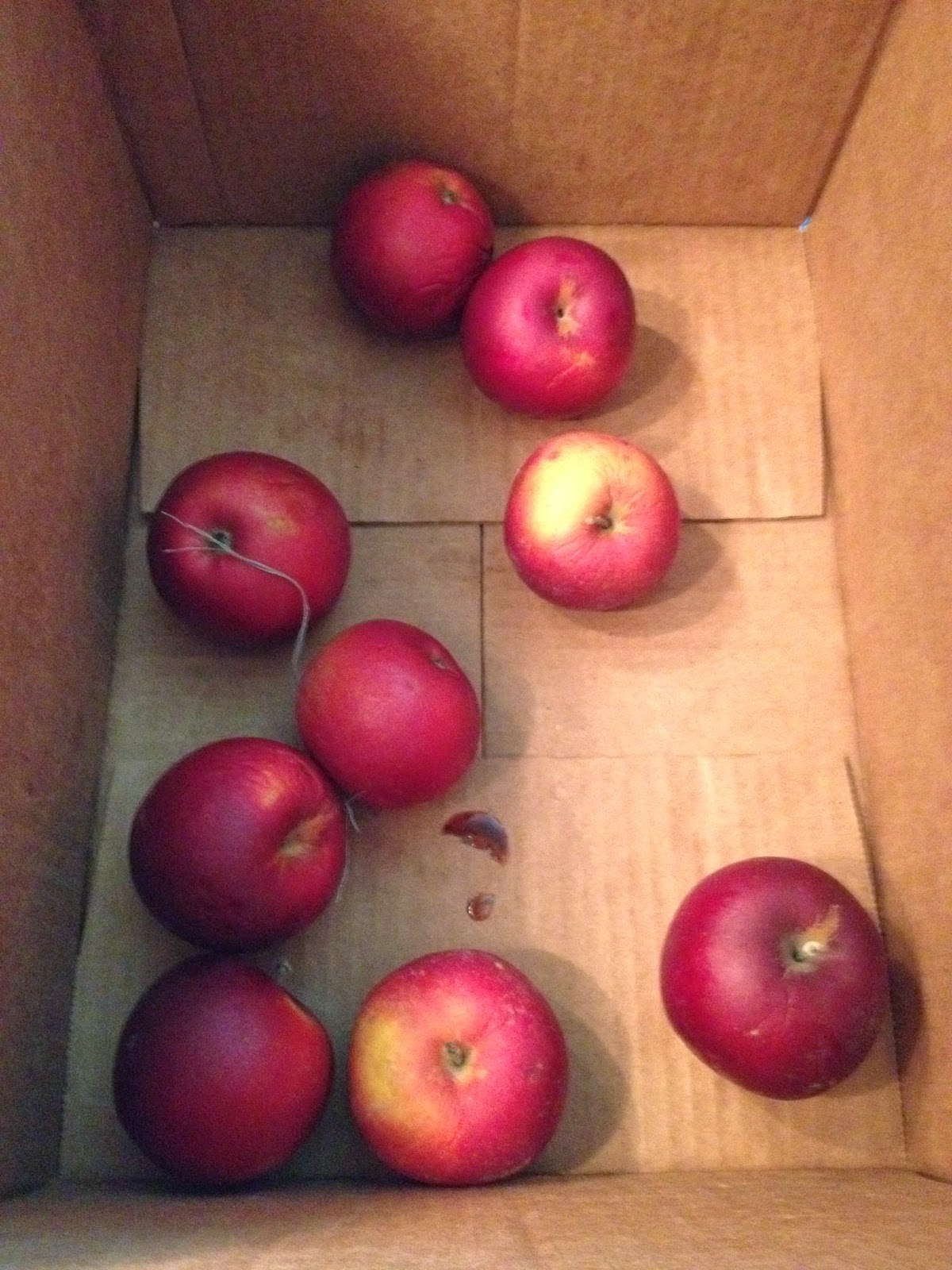
We had made a pilgrimage to our favorite local orchard, Wolfe Orchard in Monticello, to buy apples in October, right at the end of the season last year.  They advised us to keep the apples in a cool place, closed in rubber Totes containers.  Slightly dubious, we followed their instructions, and put the apples in our basement, which stays around 45-55 degrees all winter.  Different varieties take longer to develop their sweetness, they explained, so they are better stored.  They aren’t necessarily crisp for eating, but are absolutely divine when cooked or baked. The gorgeous, dark-red skinned Winesap is one such variety, so we made sure to include a peck or so in our haul.  They tasted a bit bland in the Wolfe’s tasting room, but only time would tell if the sugars developed into their full potential, hopefully around December or maybe even into January.

Well, our basement is a little….ahem…unorganized, and occasionally things get overlooked.  And so, we forgot about the Winesap apples until we unearthed the container a few days ago.  Fully expecting a disgusting mess, we were shocked to find that the apples, despite being a bit soft, were perfect for baking.  Only a couple of them were completely rotten, but the cool temperatures had kept them from affecting the whole batch.
 
Look at that color!

Didn't take me long to peel and core

Ready for cinnamon, sugar and a squeeze of lemon

This should be very good news for locavores.  I know of very few produce items that keep from October until May of the following year!  I don't recommend reproducing this experiment, but you might be surprised at the longevity of cellar-stored goods.  I'm just thrilled that there are enough of them to enjoy an apple pie and some stewed apples, and I will happily indulge in the last of the season’s bounty.

Thursday, May 1, 2014

Rainy days and deadlines


I should have known. I always work better with a deadline.  I bet you’ve noticed that I’ve been…well…absent from the blog lately.  I’ve been writing half-posts and not posting them, taking half-hearted photos, but really trying to avoid posting anything…

My raised beds aren’t done yet.

There, I said it.

I’m not making excuses, but I will say that sometimes I have to just say no to stuff sometimes.  After I posted, I was thwarted by windy weather from clearing the yard, the first step.  The following weekend—Easter weekend—I did manage to do a TON of raking, and actually got my husband to trim the weigela and other small bushes and trees in our yard.  He cut back the vines on the pergola and cut the tall prairie grasses.  I called a friend who came over and dug up the Autumn Joy sedum, some lavender and some lambs’ ears from the future raised beds site.  And then I realized I’d overdone the yard work, and would need a few days to recover.  Never fear, planning can be done comfortably from the couch, I told myself.  I asked my husband about what supplies we already had, and what we needed to buy; his answers were rather vague, but it seems we might have enough wood for a structure, and possibly have some landscape fabric, and could/might/maybe have something for vines (tomatoes, cucumbers, squash, etc.) to climb.

Then I recovered some energy just before the Illinois Marathon; I did the 5K Friday evening with my son and a friend with her baby on her back, and the 10K the next morning with other friends.  Then my husband was traveling for a conference. Then the rainy season started.  The forecast is a seven-day series of cloud and lightening bolt pictures.  A friend posted on Facebook, “Is there anything better than the sound of steady rain when you just finished planting seeds?” To which I replied, “Is there anything worse than the sound of steady rain when you know you should have already planted seeds?” 

But I have been emboldened by another friend’s comforting words, when I asked if it’s too late to plant a garden. “It is almost never too late, but you have to be flexible with the crop.”  I know it’s probably way too late for lettuce, for example, but I might be able to put some plants in, just to get a little kickstart this year. 

And then I got an email from our local co-op, which was sent as a mass mail, but seemed to be speaking directly to me:
The email read:

Do you have big plans for your garden this year?
--Why, yes I do!, I answer
Let us help take a load off your work. Local farmers have already started your garden!
--What a relief!
We’ll have tons of heirloom tomato plants, bell pepper plants, hot pepper plants, a wide variety of herbs and other vegetables – perfect timing for getting them in the ground for the season.
 [Angels singing.]

Come to find out the prices are extremely reasonable, and proceeds will be donated 100% to a program “which strives to make healthy food accessible to people of all economic levels by offering access through price and education.”  Local farms are donating all the plants!
[More angels singing.]


I immediately forwarded the email to my less-than-enthusiastic husband, and told him we now have a deadline (and I’m sure he’s wondering how he got to be a part of “we”), so we have to get going on the beds.  I assured him he would enjoy the fruit of his labor, so to speak. I’m feverishly waiting for his reply.  We all work better with deadlines, right?

So, hopefully we’ll see (there’s that “we” again) progress on this project in the next week or so.  We have a busy weekend ahead, and it’s the first weekend of the farmer’s market.  If I can drag him there, he might be persuaded to build the boxes after seeing the prices of goods at the market.  Fingers crossed!

Friday, April 11, 2014

Tabula [Not-so-] Rasa

Here is the raw material, the spot I would like to put my raised garden beds:


Well, it's sort of a crummy photo, but there was a cardinal just sitting there, looking all happy and spring-like.  (and plus, my friend Amy says cardinals are a sign of good luck) So...here's a better photo to give you an idea of size and placement.  See how sunny it is at 10:00 a.m.?


The problem is, it's not exactly a blank slate to start with.  I have all sorts of plants--miscellaneous, unplanned perennials, both planted without planning by me, or inherited from the previous owners.  See the peonies already coming up?  I know from experience that if we transplant them now, they won't come up again for a couple of years.  These peonies are special to me, though, because they originally came from my grandmother's garden over 50 years ago. They were transplanted to my parents' house in 1981 or 1982.  I transplanted them to my house in 2005.  The peonies with history will need to find a new home, unfortunately.


There are also things I can't identify:  some stray tulips?  some ramps or green onions?  a weed?


And then there's this monster weigela, which is just gorgeously resplendent with red flowers through the summer, but needs to be trimmed back to not throw too much shade on the beds.

Here's what all this looks like in the early summer, from a different angle.  Lovely blooms, but much of this will need to move, as the raised beds will be to the right of the weigela.

Before learning about raised beds, I would have moved the plants, then tilled the space with a roto-tiller or by hand.  Our soil is good there, but all the previous vegetation would have created a weeding nightmare.  With a raised bed I can put down a layer of landscape fabric or self-composting newspaper, and even a layer of chicken wire to prevent moles or voles from coming underneath, then add my soil on top.

The weather is going to be nice this weekend, so here's my overly-ambitious to-do list:

1. get rid of yard waste, leaves
2. trim weigela
3. measure space for two 4' x 4' raised beds or one 4' x 8', if possible
4. try to identify, then move or give away desirable plants
5. clear and level space for beds as much as possible

I haven't decided if I'm going to buy a pre-made structure or try to make my own.  It will require a few more nights of sleeping on it.  Meanwhile, I'm already having dreams of luscious tomatoes and huge leaf lettuce salads.

Wednesday, April 2, 2014

The Local-est of All: My Backyard


You can’t get more local than growing food in your own back yard.  Well…to be perfectly accurate, in my case it’s my side yard.  Quite a few years ago, before we re-built our garage and totally re-landscaped our house, I decided I wanted to have a garden.  As I’ve mentioned before, I grew up with a huge vegetable garden, a strawberry patch, raspberry bushes and a grape arbor.  My current back yard is not big enough for my son to even have a satisfying soccer kick, so I had to scale back.  I had seen models of raised gardens around town, but was always put off by how dingy the boards look after a couple of seasons.  Never one to do something halfway, my husband found some salvaged street pavers and made a beautiful 9’ x 5’ raised bed.  I found tomato plants, some from a friend who had grown them from seedlings.  I gleefully stuck my own seeds in the ground—beans, eggplant, melon--and waited.  I watered.  I waited.  Eventually, some little plants came up.  The tomato vines wound their way around everything else.  The broad eggplant leaves became lacy with some bug infestation.  I weeded, I waited.  After weeks and months of tending my beautiful little walled garden, the yield was….well….pitiful.  Well aware that we were fighting against the shady nature of the back yard, we didn’t know that the beautiful tree creating that shade was also poisoning our garden. Juglone, a chemical emitted by the black walnut, wreaks havoc on most anything growing below it or around it.  After two seasons of trying to find hardy plants resistant to juglone, we gave up, took up the pavers, and joined a CSA.

Last summer was the first year I didn’t join a CSA, mostly because I would be gone for most of the summer, and my husband would have been inundated with produce he wouldn’t have the first clue what to do with.  I missed the weekly haul.  When I returned from my trip, I went to the farmer’s market and paid a small fortune for vegetables I know are ridiculously easy to grow in our climate.  I vowed that this year, 2014, I would once again plant a vegetable garden.  We’ve been saving compost for quite a while, and I’ve had my eye on this sweet little spot on the south side of the house.  It’s currently got all kinds of flowers and ornamental perennials, but it’s low on shade, black walnut-free, and—now, more importantly—a dog-free zone as well.

Trouble is, I don’t know the first thing about how to build a raised bed.  Hubby used all the salvaged street pavers to make a path and retaining wall in our back yard.  I’m sure we’ve got the wood, but a handy-person I am not.  Planting time will coincide badly with Hubby’s end-of-the-semester PhD-ing, so I can’t really rely on him to build the thing.  So…I will do this the same way I do anything:  I start on the internet.  “How to build raised garden beds” yields a zillion sites and lovely photos.  (I mean, just look!  Here!  They’re all wonderful!).  It’s early April, and raining, and I’m dreaming of getting my hands and arms dirty in all that beautiful soil.  I’m dreaming of sun-ripened tomatoes, flavorful green beans sautéed in garlic ramps, leafy greens, and piquant peppers.  Surely my enthusiasm counts for something!  I still have some time, and lots of resources at my fingertips.  I’m sure I could find something at our local salvage yard if only I can think creatively.

I think they have old bathtubs for sale…