Loca-busy? Locavore?

Tuesday, May 6, 2014

Testing the limits


It’s been a long, difficult winter around here, but now the lilacs are blooming, the leaves are filling out the trees, my hostas are taking over the sidewalk, and the farmer’s market started on Saturday morning.  It was glorious to walk around seeing all the beautiful plants and arts and crafts, and the beginnings of produce.  Asparagus, our spring favorite, was everywhere, and the bunch I bought from farmer Greg was delicious. I was reminded how difficult it can be to eat local all winter, and the darkest months seem to be when the home-canned and frozen goods are running out in April and early May.  But a discovery in our basement made me realize that some of those winter goodies can be stored for an extraordinarily long time in the right conditions.

We had made a pilgrimage to our favorite local orchard, Wolfe Orchard in Monticello, to buy apples in October, right at the end of the season last year.  They advised us to keep the apples in a cool place, closed in rubber Totes containers.  Slightly dubious, we followed their instructions, and put the apples in our basement, which stays around 45-55 degrees all winter.  Different varieties take longer to develop their sweetness, they explained, so they are better stored.  They aren’t necessarily crisp for eating, but are absolutely divine when cooked or baked. The gorgeous, dark-red skinned Winesap is one such variety, so we made sure to include a peck or so in our haul.  They tasted a bit bland in the Wolfe’s tasting room, but only time would tell if the sugars developed into their full potential, hopefully around December or maybe even into January.

Well, our basement is a little….ahem…unorganized, and occasionally things get overlooked.  And so, we forgot about the Winesap apples until we unearthed the container a few days ago.  Fully expecting a disgusting mess, we were shocked to find that the apples, despite being a bit soft, were perfect for baking.  Only a couple of them were completely rotten, but the cool temperatures had kept them from affecting the whole batch.
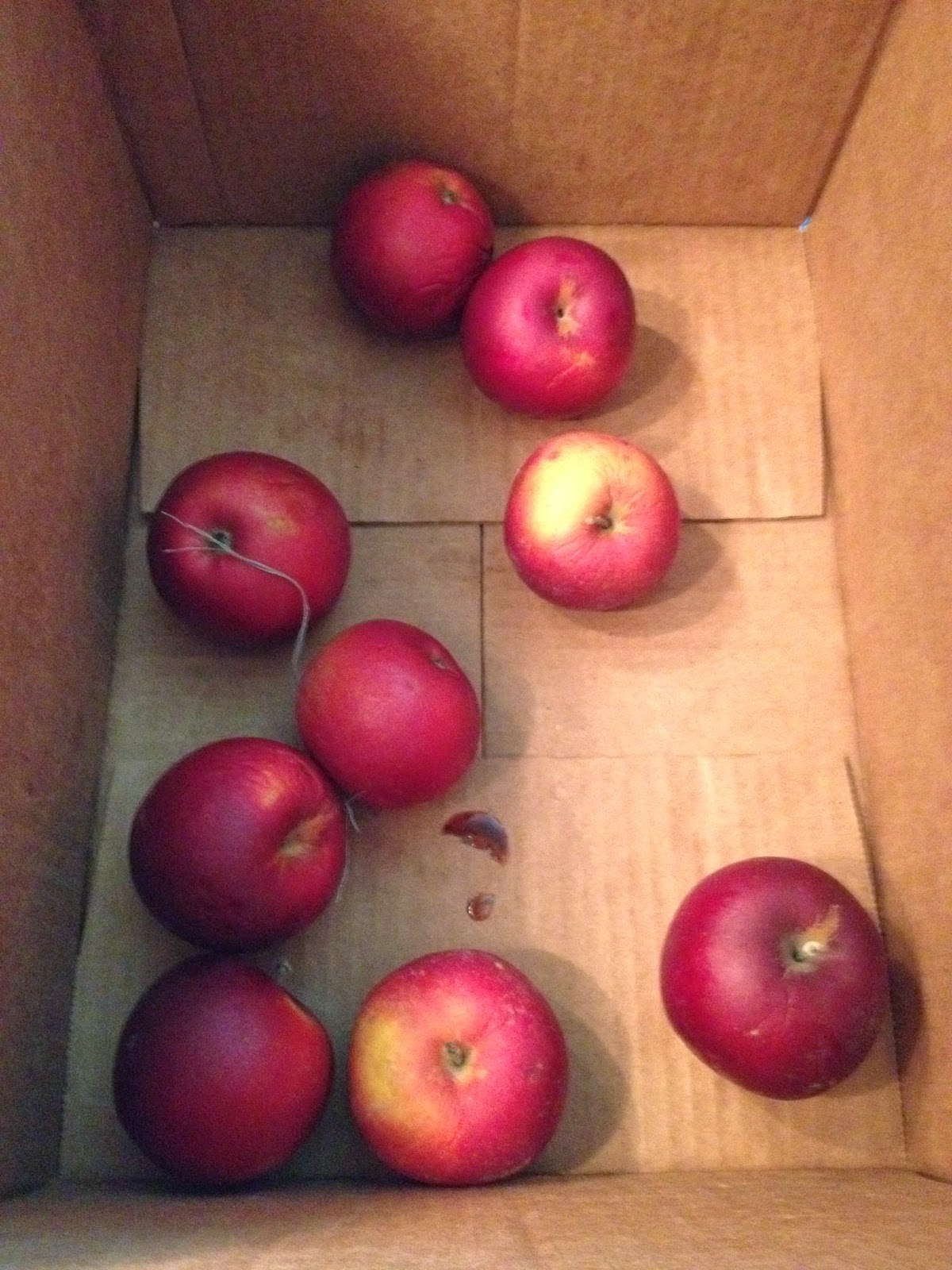
 
Look at that color!

Didn't take me long to peel and core

Ready for cinnamon, sugar and a squeeze of lemon

This should be very good news for locavores.  I know of very few produce items that keep from October until May of the following year!  I don't recommend reproducing this experiment, but you might be surprised at the longevity of cellar-stored goods.  I'm just thrilled that there are enough of them to enjoy an apple pie and some stewed apples, and I will happily indulge in the last of the season’s bounty.

Thursday, May 1, 2014

Rainy days and deadlines


I should have known. I always work better with a deadline.  I bet you’ve noticed that I’ve been…well…absent from the blog lately.  I’ve been writing half-posts and not posting them, taking half-hearted photos, but really trying to avoid posting anything…

My raised beds aren’t done yet.

There, I said it.

I’m not making excuses, but I will say that sometimes I have to just say no to stuff sometimes.  After I posted, I was thwarted by windy weather from clearing the yard, the first step.  The following weekend—Easter weekend—I did manage to do a TON of raking, and actually got my husband to trim the weigela and other small bushes and trees in our yard.  He cut back the vines on the pergola and cut the tall prairie grasses.  I called a friend who came over and dug up the Autumn Joy sedum, some lavender and some lambs’ ears from the future raised beds site.  And then I realized I’d overdone the yard work, and would need a few days to recover.  Never fear, planning can be done comfortably from the couch, I told myself.  I asked my husband about what supplies we already had, and what we needed to buy; his answers were rather vague, but it seems we might have enough wood for a structure, and possibly have some landscape fabric, and could/might/maybe have something for vines (tomatoes, cucumbers, squash, etc.) to climb.

Then I recovered some energy just before the Illinois Marathon; I did the 5K Friday evening with my son and a friend with her baby on her back, and the 10K the next morning with other friends.  Then my husband was traveling for a conference. Then the rainy season started.  The forecast is a seven-day series of cloud and lightening bolt pictures.  A friend posted on Facebook, “Is there anything better than the sound of steady rain when you just finished planting seeds?” To which I replied, “Is there anything worse than the sound of steady rain when you know you should have already planted seeds?” 

But I have been emboldened by another friend’s comforting words, when I asked if it’s too late to plant a garden. “It is almost never too late, but you have to be flexible with the crop.”  I know it’s probably way too late for lettuce, for example, but I might be able to put some plants in, just to get a little kickstart this year. 

And then I got an email from our local co-op, which was sent as a mass mail, but seemed to be speaking directly to me:
The email read:

Do you have big plans for your garden this year?
--Why, yes I do!, I answer
Let us help take a load off your work. Local farmers have already started your garden!
--What a relief!
We’ll have tons of heirloom tomato plants, bell pepper plants, hot pepper plants, a wide variety of herbs and other vegetables – perfect timing for getting them in the ground for the season.
 [Angels singing.]

Come to find out the prices are extremely reasonable, and proceeds will be donated 100% to a program “which strives to make healthy food accessible to people of all economic levels by offering access through price and education.”  Local farms are donating all the plants!
[More angels singing.]


I immediately forwarded the email to my less-than-enthusiastic husband, and told him we now have a deadline (and I’m sure he’s wondering how he got to be a part of “we”), so we have to get going on the beds.  I assured him he would enjoy the fruit of his labor, so to speak. I’m feverishly waiting for his reply.  We all work better with deadlines, right?

So, hopefully we’ll see (there’s that “we” again) progress on this project in the next week or so.  We have a busy weekend ahead, and it’s the first weekend of the farmer’s market.  If I can drag him there, he might be persuaded to build the boxes after seeing the prices of goods at the market.  Fingers crossed!

Friday, April 11, 2014

Tabula [Not-so-] Rasa

Here is the raw material, the spot I would like to put my raised garden beds:


Well, it's sort of a crummy photo, but there was a cardinal just sitting there, looking all happy and spring-like.  (and plus, my friend Amy says cardinals are a sign of good luck) So...here's a better photo to give you an idea of size and placement.  See how sunny it is at 10:00 a.m.?


The problem is, it's not exactly a blank slate to start with.  I have all sorts of plants--miscellaneous, unplanned perennials, both planted without planning by me, or inherited from the previous owners.  See the peonies already coming up?  I know from experience that if we transplant them now, they won't come up again for a couple of years.  These peonies are special to me, though, because they originally came from my grandmother's garden over 50 years ago. They were transplanted to my parents' house in 1981 or 1982.  I transplanted them to my house in 2005.  The peonies with history will need to find a new home, unfortunately.


There are also things I can't identify:  some stray tulips?  some ramps or green onions?  a weed?


And then there's this monster weigela, which is just gorgeously resplendent with red flowers through the summer, but needs to be trimmed back to not throw too much shade on the beds.

Here's what all this looks like in the early summer, from a different angle.  Lovely blooms, but much of this will need to move, as the raised beds will be to the right of the weigela.

Before learning about raised beds, I would have moved the plants, then tilled the space with a roto-tiller or by hand.  Our soil is good there, but all the previous vegetation would have created a weeding nightmare.  With a raised bed I can put down a layer of landscape fabric or self-composting newspaper, and even a layer of chicken wire to prevent moles or voles from coming underneath, then add my soil on top.

The weather is going to be nice this weekend, so here's my overly-ambitious to-do list:

1. get rid of yard waste, leaves
2. trim weigela
3. measure space for two 4' x 4' raised beds or one 4' x 8', if possible
4. try to identify, then move or give away desirable plants
5. clear and level space for beds as much as possible

I haven't decided if I'm going to buy a pre-made structure or try to make my own.  It will require a few more nights of sleeping on it.  Meanwhile, I'm already having dreams of luscious tomatoes and huge leaf lettuce salads.

Wednesday, April 2, 2014

The Local-est of All: My Backyard


You can’t get more local than growing food in your own back yard.  Well…to be perfectly accurate, in my case it’s my side yard.  Quite a few years ago, before we re-built our garage and totally re-landscaped our house, I decided I wanted to have a garden.  As I’ve mentioned before, I grew up with a huge vegetable garden, a strawberry patch, raspberry bushes and a grape arbor.  My current back yard is not big enough for my son to even have a satisfying soccer kick, so I had to scale back.  I had seen models of raised gardens around town, but was always put off by how dingy the boards look after a couple of seasons.  Never one to do something halfway, my husband found some salvaged street pavers and made a beautiful 9’ x 5’ raised bed.  I found tomato plants, some from a friend who had grown them from seedlings.  I gleefully stuck my own seeds in the ground—beans, eggplant, melon--and waited.  I watered.  I waited.  Eventually, some little plants came up.  The tomato vines wound their way around everything else.  The broad eggplant leaves became lacy with some bug infestation.  I weeded, I waited.  After weeks and months of tending my beautiful little walled garden, the yield was….well….pitiful.  Well aware that we were fighting against the shady nature of the back yard, we didn’t know that the beautiful tree creating that shade was also poisoning our garden. Juglone, a chemical emitted by the black walnut, wreaks havoc on most anything growing below it or around it.  After two seasons of trying to find hardy plants resistant to juglone, we gave up, took up the pavers, and joined a CSA.

Last summer was the first year I didn’t join a CSA, mostly because I would be gone for most of the summer, and my husband would have been inundated with produce he wouldn’t have the first clue what to do with.  I missed the weekly haul.  When I returned from my trip, I went to the farmer’s market and paid a small fortune for vegetables I know are ridiculously easy to grow in our climate.  I vowed that this year, 2014, I would once again plant a vegetable garden.  We’ve been saving compost for quite a while, and I’ve had my eye on this sweet little spot on the south side of the house.  It’s currently got all kinds of flowers and ornamental perennials, but it’s low on shade, black walnut-free, and—now, more importantly—a dog-free zone as well.

Trouble is, I don’t know the first thing about how to build a raised bed.  Hubby used all the salvaged street pavers to make a path and retaining wall in our back yard.  I’m sure we’ve got the wood, but a handy-person I am not.  Planting time will coincide badly with Hubby’s end-of-the-semester PhD-ing, so I can’t really rely on him to build the thing.  So…I will do this the same way I do anything:  I start on the internet.  “How to build raised garden beds” yields a zillion sites and lovely photos.  (I mean, just look!  Here!  They’re all wonderful!).  It’s early April, and raining, and I’m dreaming of getting my hands and arms dirty in all that beautiful soil.  I’m dreaming of sun-ripened tomatoes, flavorful green beans sautéed in garlic ramps, leafy greens, and piquant peppers.  Surely my enthusiasm counts for something!  I still have some time, and lots of resources at my fingertips.  I’m sure I could find something at our local salvage yard if only I can think creatively.

I think they have old bathtubs for sale…

Monday, March 17, 2014

Sláinte! and appreciation for slow cookers and cold storage

St. Patrick's Day always inspires me to cook corned beef and cabbage, fully aware that this is not a traditional Irish meal.  My mother called it New England boiled dinner, and that's probably more appropriate.  Call it what you may, it's a dinner that lends itself well to slow cooking, even with my incredibly slow slow cooker.  According to lore, New Englanders with Irish origins--or not--celebrated the St. Patrick's holiday with what they had on hand: a tough cut of beef that had been preserved with brine, and the last of the winter vegetables.  Onions, carrots, parsnips, potatoes, and cabbage can all be kept through the winter in cold storage.  I must have a bit of luck, because I managed to source this entire dinner locally except for the pickling spices.  Thank goodness for local farmers with good cold storage and a plentiful harvest last fall!

My co-op had local carrots from Blue Moon's fall crop, and my "back alley" farmer Greg from Claybank Farms had some beautiful little Yukon Golds and a fat onion.  Cabbage from the co-op tops off the stew.  My slow cooker gets a little kick to pre-heat, and in goes a corned beef brisket (nitrate free!) from Triple S.  The brisket doesn't come with a little convenience pack of pickling spices, so I invent my own from what I can find in the cabinet:  peppercorns, bay leaves, cloves.  I can't find mustard seed, so instead I slather a whole-grain Maille mustard over the top.  I fill up the space with water, then spread sliced onions and chunky carrots over the top.  I'll cook that sweet little brisket for four or five hours, then add the chunky Yukon Golds for the last hour or so.  I'm not a fan of mushy potatoes or cabbage, so I usually sauté the cabbage in some of the broth and serve it with the brisket instead of putting it in the slow cooker.

Now I'm sure you have your own version of this marvelous dinner; some have leeks, parsnips, and a variety of spices.  I enjoy the simple flavors of the meat cooking into the veggies for this meal.  I'll soak up the juices with a loaf of local bakery Pekara's Irish soda bread.  Now, if only Guinness were local!

Thursday, March 13, 2014

Doughnut-deprived


A couple of evenings ago, while we were eating with a friend at a Chinese buffet, my son made a startling admission.  My friend had remarked that what he was eating looked like a doughnut.

“I’ve never eaten a doughnut,” he replied.

How was that possible?!  My son has never eaten a doughnut?!

I suddenly thought guiltily of all the times as a small girl I went with my grandpa to the Donut Shop, and I always had a tough time choosing between Angel Creams and Bavarian Creams.  I was not a big fan of the cake doughnuts, preferring the yeast variety with filling.  Except for cherry.  I always hated cherry filling.  I could polish off two or three of those cream-filled babies with nary a blink of the eye.

But my son has never been to the Donut Shop.  He’s also never been to a fast food restaurant—unless you count Subway—except to go to the restroom.  That’s right.  No McDonald’s happy meals.  No Whoppers.  No drive-thrus.  When we want burgers, we go to a sit-down restaurant, or our favorite Esquire Lounge, and order burgers and fries.

I don’t think he’s suffering because of it.  He’s a healthy 5’ 1” and 110 pounds at the age of 11.  He’s got a lot of lean muscle, but still retains a small, healthy layer of baby fat, which usually completely disappears during soccer season.  He used to beg for McDonald’s, but mostly for the curiosity factor.  Now he asks to go to a Chinese buffet for sushi and egg rolls.

My son has never had a doughnut, but he’s enjoyed an aged Camembert with a crusty French baguette, something I hadn’t tasted until I was in my late teens.  He’s a huge fan of sushi and sashimi, picking up the chopsticks to tucker in.  He’s eaten wild boar and venison, slurped up raw oysters and perfectly cooked mussels.  He loves clam chowder and “green soup” made with a variety of green vegetables, including spinach.  He downs kale chips at the speed of light.  He’s sampled mangoes, litchis, papaya, pomegranates, and is a big fan of all of them.  He even fearlessly tasted chapulines, the roasted grasshoppers sold on the street in Oaxaca, Mexico.  He said he preferred the lime to the chili-flavored variety.

I’m under no illusion that he will never eat junk food.  I grew up without a television, and when I first moved into my own apartment, I spent many a sleepless night watching a lot of HBO, late-night re-runs, and a lot of other garbage, before I finally realized TV was not all it’s cracked up to be.  I can picture him going out with his teenage friends and tearing into a Big Mac or sharing a box of Krispy Kremes.  My only hope is that at some point he will remember his mother’s love affair with simple, fresh, organic, local, delicious, real food; hopefully, he will occasionally come home for supper and tell me that there’s nothing like home cooking to feed the body and the soul.

Now, to find a good doughnut recipe…

Wednesday, February 26, 2014

Local International: from Turkey


It has occurred to me that this blog has been sadly neglected.  Of course, sometimes life gets in the way; in this case it was:  a new puppy, a stressed-out husband, a stressed-out houseguest/roommate, a freelance editing job, holidays, snow days, brutal winter weather (making doing everything else take twice as long), and a child who’s been swamped with homework.  But, never fear, we have still been cooking and eating local!  Winter is the time when you have to be most creative, and depend a lot on stored items and the local co-op to maintain your connection to local ingredients.

Our friend has been staying with us for a few weeks, and—lucky for us—has brought her own brand of “local.”  She’s brought some preserved items from her parents’ garden in her native Turkey:  walnuts, hazelnuts, tomato paste, herbs, and spices that still have the flavor of the sun in them.  I realized I’d never really tasted hazelnuts until I sampled the ones her father had roasted.  We were in for a special treat on Sunday when she and I “slaved” away in the kitchen, side by side.  I made my stuffed peppers (which I’m sure will be featured in a future blog post), and she made Turkish dolma; both are labors of love.  I watched her as carefully as I could (trying to avoid chopping off one of my fingers at the same time), so that hopefully I could recreate the dish at a later time.

She started with organic collard greens.  After washing the leaves and trimming the stems, she put them to boil for about 30 minutes, so that the leaves would be nice and pliable.  Then she squeezed and drained the blood out of a pound of ground beef from our local Triple S Farms.  She explained to me that this was always a disgusting task for her since living in the U.S.  Meat in Turkey is halal, made according to Muslim standards.  Butchered meat is drained of excess blood for a significant period of time before it can be cooked and consumed.  I had to agree with her that meat wouldn’t be as unpleasant to prepare if it didn’t have so much blood!

To the ground beef she generously added salt, pepper, fresh chopped parsley, grated onions, and uncooked white rice.  (I’m fairly sure there were some ingredients in there I didn’t see while I was busy making my peppers.)  The mixture ended up fairly sticky, and when the collard greens were done, she flattened the spine of each leaf, and painstakingly rolled up a couple of tablespoons of the ground beef mixture into a tiny, cigar-shaped and –sized roll, tucking in the sides as she went.  The little rolls went side-by-side into a dutch oven.  When she ended up with too much of the ground beef and not enough collard green leaves, she stuffed a couple of small onions and a red pepper with the mixture. 
photos courtesy of Nesrin
She covered the whole thing in her mother’s tomato paste, which she had watered down enough to make a thin sauce.  The dolmas needed to be weighted down with a plate so they wouldn’t open during cooking.  On went the lid, and back to the stove to simmer for 30-40 minutes.  The dolmas were done when a sample showed the meat and rice were cooked thoroughly; the rice cooks with the added liquid and moisture of the collard greens.
 
Beautiful and delicious


The dolmas came off the stove, and the stuffed peppers out of the oven, right before our favorite Downton Abbey.  So we hauled our plates, silverware, napkins, tray of peppers, tray of dolmas, and a container of full-fat organic yogurt to top the dolmas up to the TV room.  I have to say, the TV show didn't hold my attention nearly as well as the delicately wrapped dolmas topped with creamy yogurt.  What a feast!